
A makeup drawer can contain a jar marked 12M, a tube with a calendar date and a bottle carrying a code that looks like neither. These markings do not all start the same clock. Understanding which is which is more useful than assuming every number on the package is an expiry date.
The practical aim is to connect the product’s instructions with your own record of opening and storage. A label cannot reconstruct when a jar was first used, and a purchase receipt does not necessarily answer that question.
Separate a calendar date from a duration
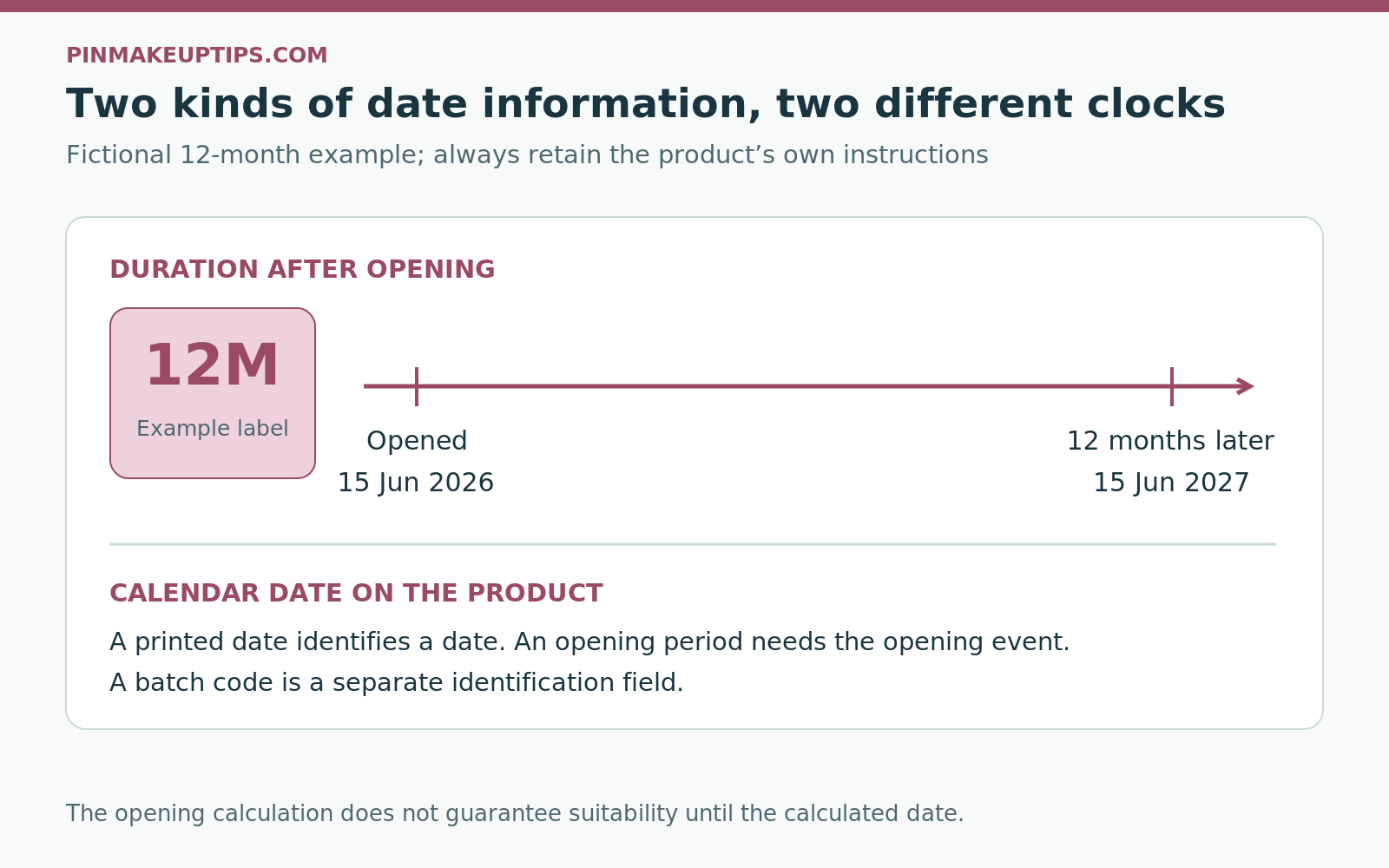
A calendar date identifies a point in time. A duration describes an interval that needs a starting event. The open-jar symbol followed by a number and M refers to a period after opening, with the number expressed in months.
In a fictional example, a product marked 12M is first opened on 15 June 2026. Adding twelve months gives 15 June 2027 as the date indicated by that opening-based interval. Buying the jar in January does not make January the opening date if the product remained unopened until June.
This calculation is a record-keeping example, not a guarantee about an individual product. Other instructions, storage conditions or reasons to stop using it can remain relevant before the calculated date.
Read the market-specific explanation
European cosmetic labelling distinguishes minimum durability from the period after opening. Article 19 of the EU Cosmetics Regulation describes the relevant labelling framework, including the opening-period indication for products with durability beyond thirty months when that concept is relevant.
That does not mean every cosmetic worldwide must carry the same marks. The FDA’s explanation of cosmetic shelf life describes the US context and distinguishes cosmetics from products that are also regulated as drugs, such as some products with sunscreen claims.
When a label seems unfamiliar, identify the market and product type before searching for a universal interpretation. A photograph showing only one corner of the container may omit the wording needed to understand the symbol.
Do not convert a batch code into an opening date
A batch or lot code identifies a production grouping or other manufacturing reference. It is not a record of your first use. Even when part of a code can be interpreted as manufacturing information, it does not reveal the conditions a particular item experienced afterward.
Online code calculators can also create false precision if their rules do not match the manufacturer’s current coding system. For an unclear code, the brand or responsible supplier is the appropriate place to request an explanation.
Keep the batch code in your own notes because it can help identify the item. Give it a separate field from purchase date, opening date and the manufacturer’s stated durability information. Four short fields prevent four different concepts from collapsing into one.
Make the record while the product is new
Take a clear photo of the label and write the first-opening date on a small tag or in a phone note. Include the exact product variant, since similar packaging can conceal different formulas or instructions. A record that says only foundation becomes ambiguous when two bottles are in use.
For a shared household, agree on what first opening means in the record. Someone may remove the seal to inspect the product and put it back before regular use begins. The useful date is the event that starts the manufacturer’s opening-based interval, not the date that is easiest to remember later.
A simple table can contain product, opening date, label information and storage note. It does not need a daily diary. The goal is to preserve a few facts that are otherwise easily lost.
Keep the product history attached to the container
Decanting into an unlabelled pot can separate the contents from the original instructions and batch reference. If a suitable transfer is permitted by the manufacturer, retain those details with the new container rather than relying on memory.
Refilling an old container creates another tracking problem: the age of the container and the age of its current contents differ. A previous opening date should not silently become the date for a new fill. Follow the refill system’s instructions and record the relevant event clearly.
Likewise, a travel-size amount and the original full-size product may have different handling histories. Labelling them as though they were still one untouched item removes information that could matter later.
Understand why appearance is an incomplete check
Changes in smell, texture, colour or separation can be reasons to question a product, but a familiar appearance is not proof that every relevant property remains unchanged. A home inspection is different from a manufacturer’s stability or microbiological assessment.
The reverse is also important: you should not invent a chemical diagnosis from one visible change. A thicker texture might have several explanations. The practical response is to follow the instructions and seek clarification where needed, rather than deciding that a particular ingredient has certainly oxidised.
For a product used near the eyes or on irritated skin, do not treat a date calculation as permission to ignore a problem. The label’s interval and the suitability of continued use are related questions, not identical ones.
Let storage notes remain factual
A useful storage note says what happened: left in a hot car for an afternoon, for example. Writing ruined or completely safe adds a conclusion that the note itself cannot establish. The manufacturer can provide product-specific guidance when the history is uncertain.
Keep containers and applicators handled according to their directions. Avoid improvising ways to restore a dried product by adding water or other materials. Altering the contents creates a new situation that the original label did not necessarily evaluate.
Do not assume that moving a product to a different temperature extends its labelled life. Storage changes should follow the manufacturer’s advice rather than an unsupported attempt to restart the clock.
Use the distinction when comparing newer ingredients
A peptide serum, a basic moisturiser and a colour cosmetic all need their own product information. An ingredient’s scientific reputation does not replace the finished formula’s instructions, packaging or stability assessment.
When you next compare two products, begin with the exact item and its stated dates or intervals. Record when it was opened, keep the batch reference and preserve any relevant handling history. That small habit makes the label useful without asking it to answer questions it was never designed to track.